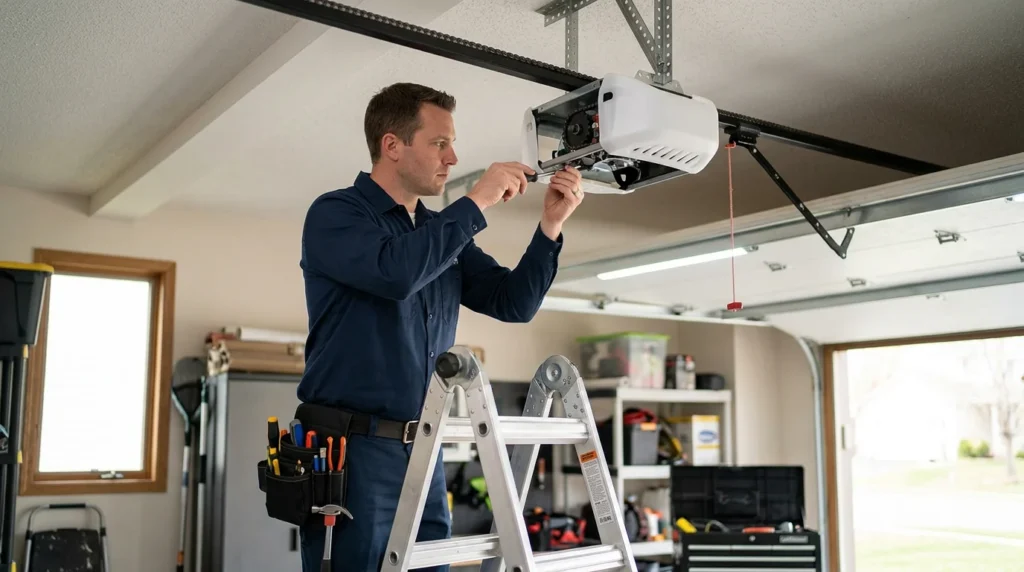
Quick answer: Most LiftMaster openers can be repaired if the motor runs but the door won’t move, the remote range suddenly drops, or the unit behaves inconsistently due to sensors, wiring, gears, or a failing logic board. Replacement is more likely if the opener is very old, parts are discontinued, or the motor is failing repeatedly. A quick on-site check can confirm which path is safer and more cost-effective.
Fast Clues That Point to Repair
If the opener hums or the lights come on but the door doesn’t move, the problem is often mechanical or electrical around the drive system rather than the whole unit being “dead.” Common repairable issues include stripped nylon gears (you may hear grinding), a loose chain/belt, a damaged sprocket, or a misaligned trolley that isn’t engaging correctly.
Safety sensors cause a lot of false “opener failures.” If the door starts down and reverses, or the opener clicks but won’t close, check for sensor lights that are off or flickering, dirty lenses, bumped brackets, or a pinched sensor wire. If you’re looking for liftmaster opener repair apple valley mn, focus your description on what the door does (won’t open, won’t close, reverses, or stops partway), because that symptom pattern usually points to the right subsystem faster than brand or location keywords.
Intermittent behavior can also be simple: weak remote batteries, a failing wall button, or an opener that’s overheating and shutting down. If the opener works again after cooling off, that often suggests the unit is being stressed by a binding door, a tired motor, or an electrical component that needs confirm-with-testing troubleshooting.
Quick Self-Triage Decision Flow
Use this as a fast sorting tool before you spend time on deep troubleshooting. It won’t replace proper testing, but it can help you decide what’s most likely.
- Repair likely: Opener runs/hums and lights come on, but the door doesn’t move; you hear grinding; the chain/belt looks slack or the trolley isn’t pulling.
- Repair likely: Door won’t close and immediately reverses, and one or both sensor lights are off/flickering (often alignment, dirty lens, or wiring).
- Replace likely: Repeated shutdowns, strong burning/electrical smell, or recurring failures after prior repairs (could be motor or control board, confirmed by testing).
- Replace likely: Parts are hard to source for your specific model/age, or the opener lacks features you want and you’re already facing major component replacement.
- Door issue (not the opener): Door feels heavy, jerky, or won’t stay near mid-height when disconnected from the opener (springs/rollers/track need attention).
Signs Replacement Makes More Sense
Replacement is usually the better call when the motor seems to be failing (for example, repeated thermal shutdowns or persistent loud straining) or the logic board appears unreliable (such as inconsistent response to controls). Those symptoms can overlap with wiring problems, accessory faults, or a door that’s binding, so a technician typically confirms the cause with basic electrical and mechanical tests before recommending a new unit.
Another reason is parts availability—some older units don’t have readily available gears, boards, or receiver components. Newer openers also add practical upgrades you may want anyway: quieter operation, better LED lighting, battery backup options, and modern wireless security features.
If the opener is fine but the door is heavy, jerky, or hard to lift by hand, replacing the opener alone won’t fix the root cause. In that case, the door’s springs, rollers, hinges, or track alignment may be the real issue, and addressing those items can protect any opener you install.
What You Can Check Safely and What to Tell the Technician
Start with the door itself. Pull the red emergency release (with the door closed) and lift the door by hand. A properly balanced door should lift smoothly and stay around mid-height with minimal drift. If it slams down or shoots up, the springs are out of balance or failing—stop there, because spring work is dangerous and should be handled by a pro.
Next, look at the photo eyes near the floor. Ensure both are aimed at each other, their lenses are clean, and the wiring isn’t stapled too tightly or damaged. Also confirm the opener isn’t in “lock” or “vacation” mode on the wall control, which can make remotes seem dead. Sounds can help too: grinding often correlates with worn drive parts, and a click/no-move situation can have multiple causes that should be confirmed with testing.
When you schedule service, a short checklist helps the tech arrive prepared: the opener model number (from the label on the unit), approximate opener age, what the door does (won’t open/close, reverses, stops partway, intermittent), whether the sensor lights are solid or flickering, and what happened during the door-balance hand test (smooth and stays mid-height vs heavy/drops). For help diagnosing a LiftMaster opener issue and getting it working safely again, contact AA Garage Door LLC.